

Brazil's proposed RE Laws; National Security Fetish; RE & Penalties; Malawi RE Export Ban; Aclara's Carina PEA; MP's Q1 & HREE; BCM, Arafura, USARE, Victory and the lot.
Rare Earth 10 May 2026 #198
Note
This month it is 6 years of The Rare Earth Observer. Raw and unrefined, no holds barred. Rooted in fact, not fiction.
Brutal honesty also applies to The Rare Earth Observer and to our precious contributors. In that spirit we issue corrections when wrong.
Correction
In our previous post we wrongly attributed the Halleck Creek rare earth deposit to ReAlloys.
Correct is that ReAlloys relate to the Sheep Creek deposit.
For those who are interested in the Sheep Creek hype and where it originates from, here our original post on Sheep Creek.
Even ReAlloys want to have nothing to do with Halleck Creek.
Presidents meet
In the coming week there is the presidential meeting between China and USA. As a result of the last meeting in Ulsan in October 2025 the US-President announced that there was a deal and that all of the rare earth had been settled. “And that is for the world, world-wide”.
Well, quite apparently, the deal wasn’t what the President proclaimed. Neither for the US, nor worldwide. Someone may not have been quite on top of the details.
We wonder what will be the results this time.
Chinese media are full of rare earthy articles ahead of the US-President’s visit. Perhaps the US-side wants to read this article from China’s sohu.com website on the flight to Beijing (machine translated):

Of course there are numerous propaganda elements in the article, also omissions of facts that don’t fit the bright China picture.
Recycling
The German newspaper Tagesspiegel carried an article The EU will strengthen recycling to secure rare earths and permanent magnets. An excerpt:
No data available on wind turbines with neodymium magnets
In the wind energy sector, permanent magnets containing rare earth elements have not yet become standard practice for all manufacturers. Nordex, the market leader for onshore turbines in Germany, does not use permanent magnets in its turbine models, according to a company statement. The major European manufacturers Enercon, Siemens Gamesa, and Vestas do use neodymium magnets, but not yet recycled rare earth elements. “Currently, there are no recycling loops like those that exist for steel or copper,” said Enercon spokesperson Felix Rehwald.
At this time there are no recycling loops yet, different from those for steel or copper.
Wind turbines with neodymium permanent magnets were developed by the Dutch company Lagerwey in the early 1990s and have been manufactured on an industrial scale since 2010. Their lifespan is between 20 and 35 years. Therefore, there are hardly any turbines available for recycling today.
A complicating factor for the recycling industry is the fact that no one knows exactly how many wind turbines with neodymium magnets are in operation in the EU. “National databases contain only limited information about the design type and material composition of historical wind turbines. A systematic and realistic estimate is therefore difficult,” stated WindEurope, the European wind energy lobby group, in response to an inquiry.
A detailed KU Leuven paper of 2022 says:
Europe is aiming to produce only 25% of its permanent magnet needs as a base case, and so secondary supply could play a very significant role after 2040 once permanent magnets become available for recycling (assuming economic and technical bottlenecks are solved).
So much about medium term recycling of wind turbine rare earth permanent magnets.
For arguments sake, one could say:
Western rare earth dependence ≠ rare earth permanent magnet dependence.
Simple truth is that the rare earth content of rare earth permanent magnets does not address the West’s common rare earth (lanthanide) needs.
Why:
The Fabulous Four “magnet rare earths” (Pr, Nd, Tb, Dy) are ca. 92% of the overall rare earth world market value.
The Chinese rare earths the West (excluding Japan) depends on are among the remaining ca. 8%, not the Fabulous Four.
Proof:
The 4 April 2025 Chinese dual-use export license restrictions are for seven rare earths: Scandium, Samarium, Terbium, Dysprosium, Gadolinium, Lutetium and Yttrium. They hit at the heart of the rare earth import dependence of the US.
Scandium is a different league. From the remaining six restricted, only two were on western rare earth hopefuls’ radar. No joke: A western rare earth company, whom we will not name, literally could not even spell some of these correctly in a public corporate presentation.
And so the US-Yttrium debacle hit everyone as a complete surprise. Not only is the importance of Yttrium universally underestimated, it was also named “the next Lanthanum” (pointing at La oversupply), underestimating the significant growth of Yttrium use.
In the light of this, how the Fabulous Four, Praseodymium, Neodymium, Terbium and Dysprosium recycled from rare earth permanent magnets, can be considered an overall rare earth dependency solution, fully escapes us.
Come 10 November 2026, when China will likely expand restrictions on yet another five rare earths, there will be more surprises in store. Suddenly and unexpectedly the West will discover crippling shortages among these five, too. Rare earths, which no rare earth hopeful is talking about.
For a bit of good, clean, wholesome fun, only look at the rare earths used in components for AI datacenters. The West’s next big thing could potentially be crippled by China.
Western rare earth hopefuls wanting to offer “solutions” to the rare earth dependence should supply the full range of the Lanthanides plus Yttrium to the maximum extractable from the relevant resource. Else these are not solutions, not even bandaids.
Energy Fuels, MP and Lynas have meanwhile somewhat heard the explosions, while the rest of the pack seems to be mired in self-created corporate fog.
National security
Honestly, watching governments slap a 'National Security' sticker on everything that moves is becoming the most predictable comedy act in town.
Bureaucrat zealots will sometimes identify an entirely perceived issue as yet another threat to national security. Running their course national security zealots direct the focus on ever more of ever smaller and arguably ever less relevant “national security issues”.
National security becomes a nationwide, paranoia-fuelled race to the bottom. At the current rate, Chinese will eventually need a security clearance just to buy a bicycle.
There would be precedence.
Up to the late 1980s Chinese needed a government-issued coupon from their cradle-to-grave socialist work unit (单位 danwei) for buying a bicycle. Or for getting married. Or for buying a long distance bus ticket. A permit from the work unit was needed for literally everything.
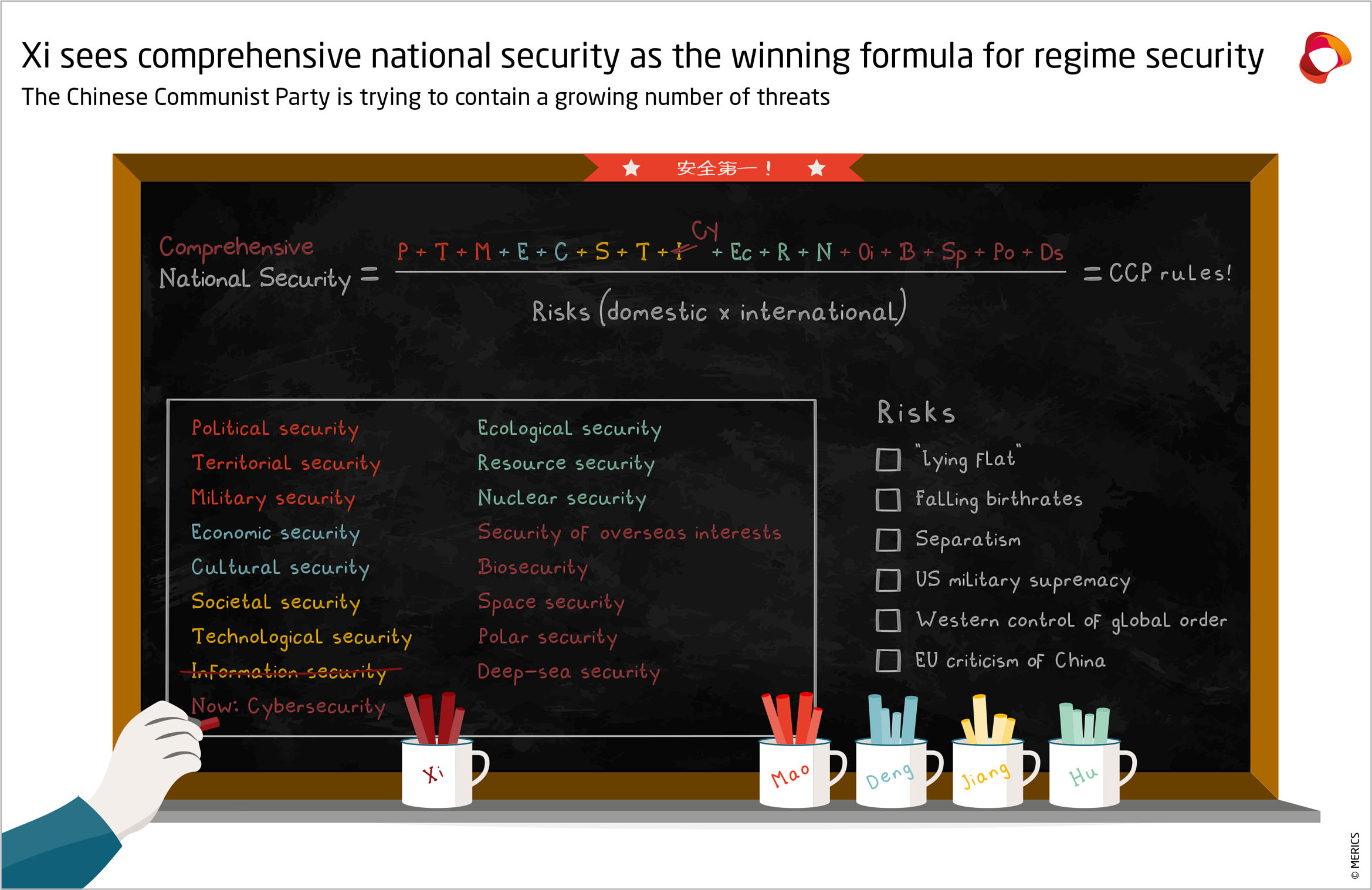
MERICS write:
Xi’s concept of “comprehensive national security” (总体国家安全) was officially introduced in 2014 and now comprises 16 security arenas deemed essential to China’s development and the party state’s survival by keeping China domestically stable and internationally thriving. The concept is closely linked to achieving the “rejuvenation of the Chinese nation” by 2049 and has been encoded in the revised Party Constitution and various party documents and laws.1
In the process also rare earths have been declared a matter of national security.
This is not limited to China. National security has become a trendy thing and it is being rolled out all over the world. Bureaucrats just love it, as it gives bureaucracies ever more bloat potential.
Simple truth is, however that — unless you have reached a stage of North Korea — you will never achieve national security. A futile quest.
This world and its economies strive on interconnection through trade, communication and all other kind of exchanges, not on the lack thereof.

Amanda Lacaze’s Address to the National Press Club of Australia
Probably Mrs Lacaze’s final public address as CEO of Lynas. She is pretty spot on, respect!
No market is ever fixed from the supply-side.
Armanda Lacaze
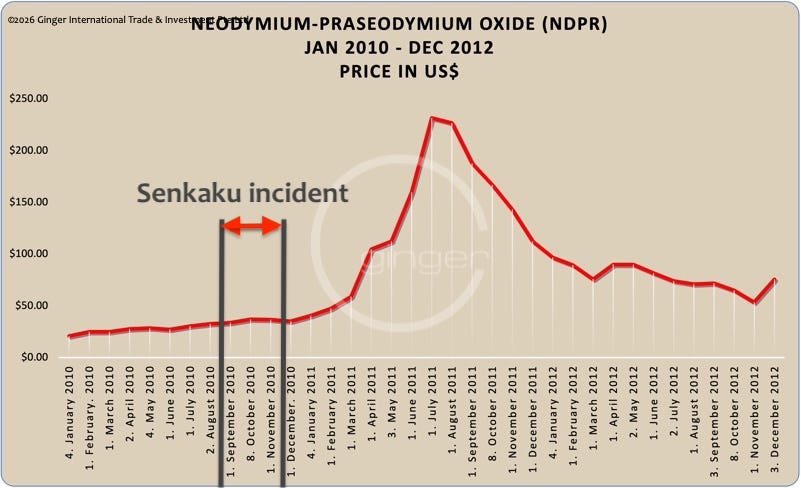
We disagree how she put the 2010/2011 rare earth crisis. The fishing boat incident was merely a 6 week episode between early September and beginning of November, 2010, when the conflict ended.
China suspended rare earth shipments to Japan on 21 September 2010 to force Japan into submission regarding the Chinese fishing trawler and its captain. Japan decided it was not worth the hassle and complied with China’s demands.
China’s rare earth shipments to Japan resumed on 28 October 2010.
China’s rare earth export quota had been cut by ca. 40% at the beginning of 2010. When China announced a further rare earth export quota reduction at the end of 2011, problems started.
Rare earth prices sky-rocketed from Q1 2011, long after the fishing boat incident had been settled. Prices peaked on 20 July 2011.
This, according to our research, should have been primarily related to a relentless domestic compliance campaign in China in 2011, during the course of which reportedly more than 80 domestic rare earth separation sites were temporarily closed for rectification. This campaign came, after a campaign in 2010 had failed to yield results.
Adamas did some good
How much rare earths does an F-35 really contain?
There is this ages-old myth about 400 kgs or so rare earths in an F-35.
Adamas sat down, worked hard and busted this myth. Here the result:
