

China-Japan RE Dejavu; Russian Navy's RE Dependency; US-Delusions; Ramaco's Rotten Berries; And the Lot.
Rare Earth 17 January 2026 #192
Note
In the “Companies” section today we attend to our “darlings” Ucore, USA Rare Earths, Namibia Rare Earths and Ramaco with its “rotten berries”. We look at NCM’s feasibility study, too.
By the way, do you remember the EU wanted to invest €10 billion in the Trans-Caspian Corridor in order to connect the EU with Central Asia? It also connects to the Trump Route for International Peace and Prosperity (TRIPP - no, this is no joke). The use of this route, according to Nikkei Asia:
40% of containerized cargo that arrives at Baku port originates in China, ranging from vehicles to garments, while the remaining cargo comes from other Central Asian countries. The volume of goods transported on the return journey to China remains limited and consists mainly of mineral fuels, lubricants, and other related products.
Rare Earths are good for headlines in the USA. Otherwise, they disappear in the data.
The Savvy Yabby Report of Jevons Global Pty Ltd
Well, not quite. They make headlines everywhere.
Basically, China does not like a self-confident Japan, or Korea, or Taiwan, or Vietnam, or anybody else who does not pay proper tribute to China’s universal greatness. In the age of Xi Jin Ping China demands respect.
China’s Xi particularly dislikes Japan’s Prime Minister Takaichi. He wants her gone.
What happened?
Japanese Prime Minister Takaichi gave Xi the perfect through-pass in front of an open goal. Against the advice of her seasoned bureaucrats she had said in Japan’s Lower House on 7 November 2025 that a Taiwan crisis might constitute a “survival-threatening situation” for Japan. Which would mean that Japan could intervene legally using its armed forces.
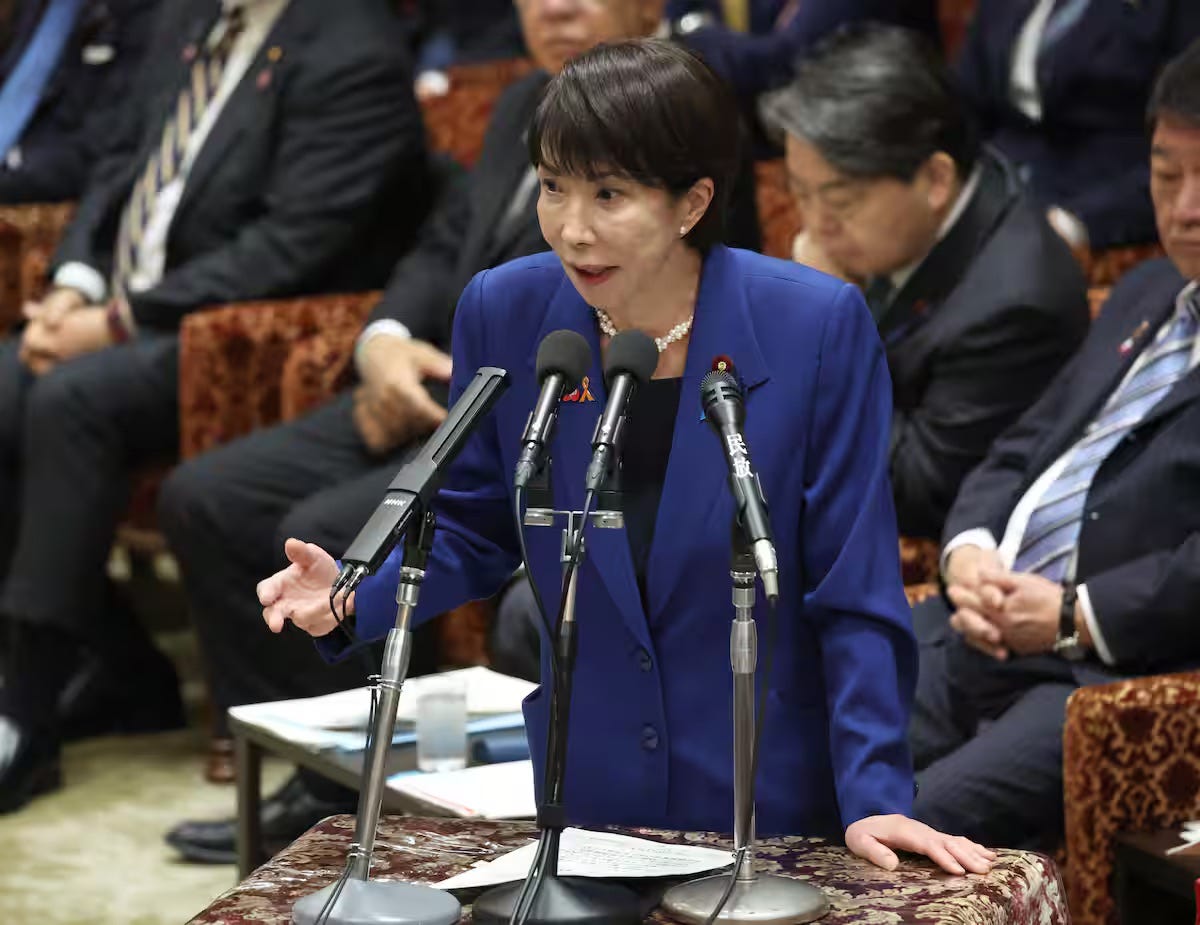
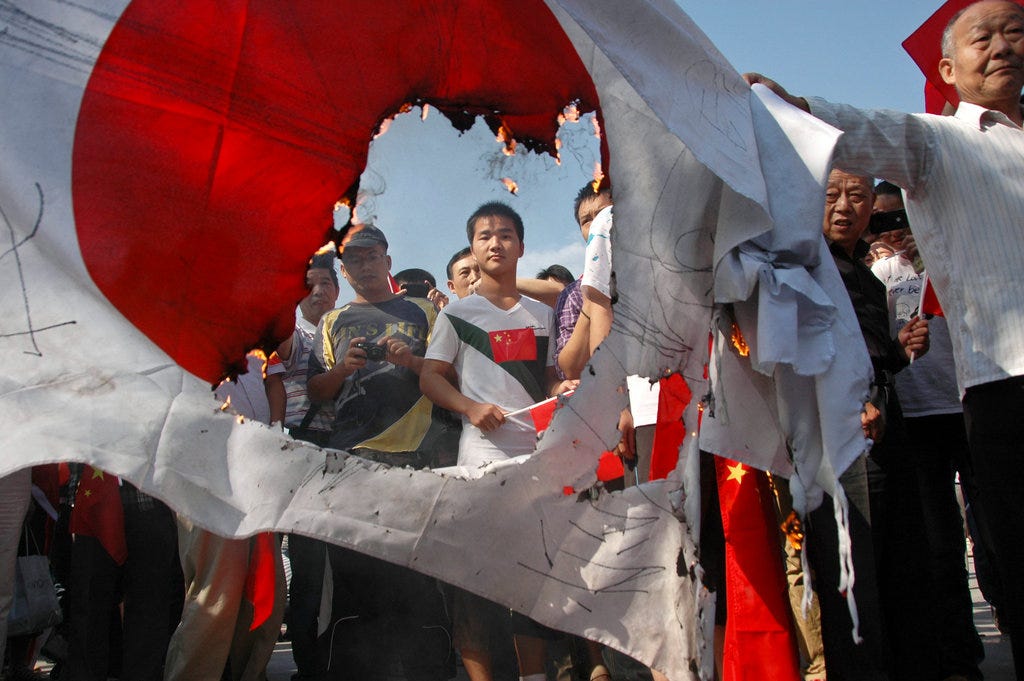
Chinese, who have been brainwashed for generations with historical revisionism of the kind that has led straight to wars elsewhere, started vomiting blood in anger.
Because Taiwan is sacred Chinese territory. Any war between Mainland China and Taiwan is viewed as an internal matter and thus should have nothing to do with Japan.
The reaction
China demanded a full retraction of Takaichi’s statement. Obviously, this would mean loss of face for the Japanese PM and her political future would have been toast. So the best she could offer was not to repeat the remark.
This of course implies that her original statement still stands, which is not acceptable to Xi. He has made unification with Taiwan a core objective of his political legacy. Either Taiwan surrenders voluntarily or he will use force, no matter what it may cost.
Since he does not get his way, in good-old China copy-paste tradition, Xi re-tries the 2010 rare earth stunt with Japan, hoping that same as back then Japan falls over.
If it has been Foreign Minister Wang Yi, a first-class Japan expert and fulminant diplomat, who had offered this crappy advice then it would be very disappointing.
False assumptions
Takaichi’s mentor, the arch-conservative falcon Shinzo Abe, entered office in late 2012.
Abe’s rise to prime minister had been a direct result of the militant Chinese hostility towards Japan and the first rare earth crisis. Abe became the longest-serving prime minister in Japan’s post-war history. It that had not been in China’s favour.
And now Takaichi, surfing on high approval ratings, has called a snap election for February in order to solidify her party’s position in the coalition government.
Japan and rare earths:
Japan is the single largest market for rare earth outside China
Japan stands 40-50% of the export value of rare earth compounds from China
Japan stands for >60% of the export value of rare earth metals from China
Since the 2010 crisis Japan holds buffer stocks carrying it comfortably through several months of whatever Chinese Rumpelstilz dances.
Since 2010 Japan’s rare earth dependence on China in light rare earths has been diminished.
Xi may have assessed the Japanese political situation wrongly and he may be shooting China’s rare earth industry in the foot, when embargoing Japan.
Or so it seems.
Avid readers of this humble publication will remember that in our view all and any Chinese rules, regulations, measures and implementation instructions are always dual-purpose. Apart from the obvious economic coercion and political punishment, alienating Japan in rare earths may serve the purpose of overall reduction of rare earth exports,
We believe China may be on a quest to reduce its rare earth production to only serve domestic needs, just like the Ministry of Industry & Information Technology had announced in 2014 to the visitors of the EU Raw Materials Group from Brussels.
Hostility
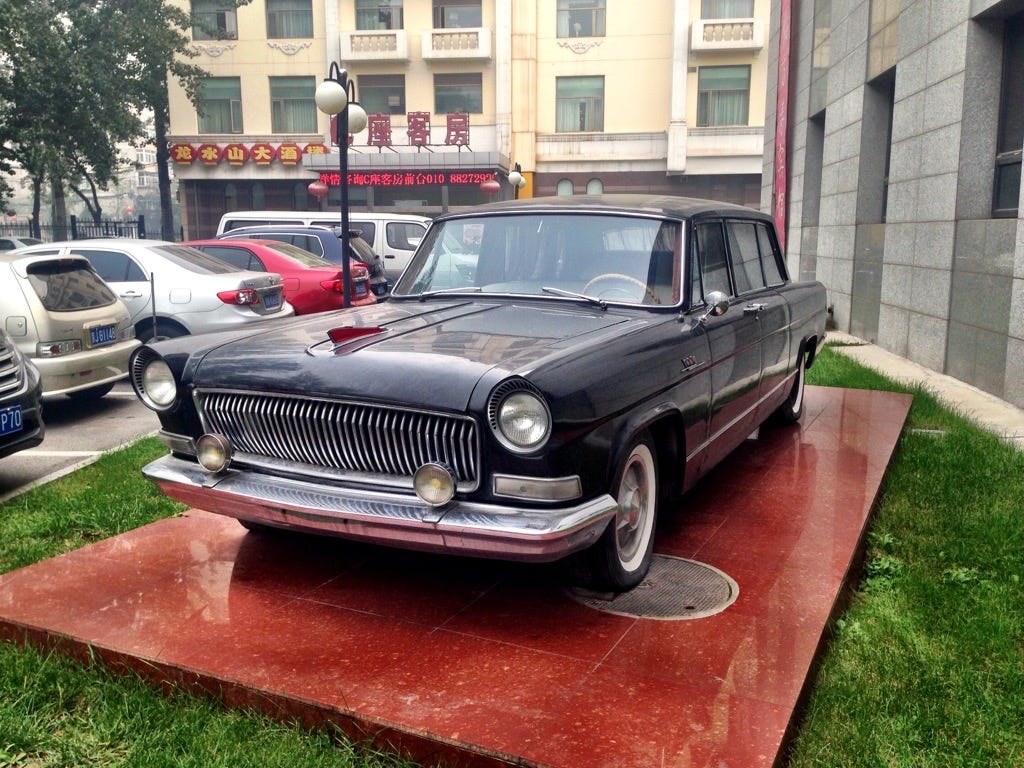
There is an underlying hostility towards Japan, resulting from unspeakable war crimes committed during WWII that it never officially apologised for.
From barbaric decapitation contests among Japanese officers in East China and Taiwan plus the Nanjing Massacre, via experiments how long Chinese can survive without skin and hideous mass rape of Korean “comfort women”, to machine gun mass-executions of civilians on Singapore’s beaches, there is quite a lot to be sorry for in Japan.
Post-WWII, in order to save face, Japan didn’t really apologise and tried to make up in other ways. This was kind of grudgingly acknowledged by Taiwan, Singapore and its South East Asian neighbours.
Trade and investment as a replacement for apology also was formational for Japan’s relationship to Taiwan. It made Taiwan among Japan’s top four important trade and investment partners.
Japan’s China problem
Communism is like a religion. It has its saints (bearded guys looking grumpy on posters), catechisms (lengthy pamphlets that nobody finishes but everyone quotes), rites (after a marathon speech of some bigwig everyone claps and no-one wants to be the first to stop) and of course a big book (to which every leader adds his own highly elaborate thoughts - no matter how profane). And you have got to believe in it, else it won’t work for you.
As a religion Communism absolutely requires symbolism, no matter how hollow and disingenuous.
And that symbolic bit is where Japan has fallen short: a full and unambiguous WWII apology of the Japanese Emperor to China.
By the way
In general all Asian nations always view themselves exclusively as victims, whether perpetrators or not.
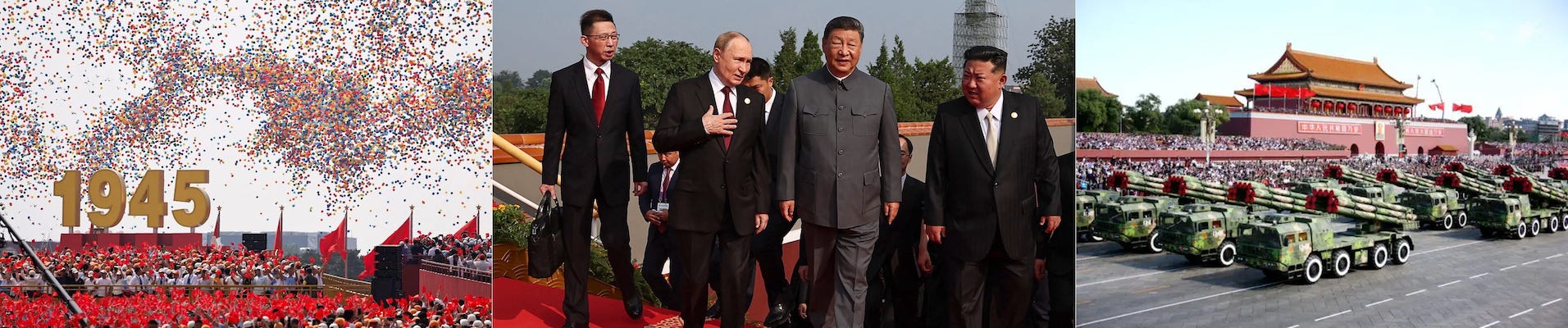
Last year Xi’s China tried to depart from the victim role when trying to portrait itself as a glorious WWII winner, when in reality it had been an exhausted, divided and destroyed nation that had absolutely no strength at all left to deal with a foreign invader. China was so broken that at the end of WWII Japanese commanders had trouble finding someone to surrender to.
Xi practices the very historic denialism he accuses others of.
But that is another story.
MOFCOM - The Rare Earth Stranglers
Ministry of Commerce Announcement No. 1 of 2026: Announcement on Strengthening Export Controls on Dual-Use Items to Japan
[Issuing Authority] Bureau of Safety and Control
[Document Number] Announcement No. 1 of 2026 issued by the Ministry of Commerce
[Date of Issuance] January 6, 2026In accordance with the relevant provisions of the Export Control Law of the People’s Republic of China and other laws and regulations, and in order to safeguard national security and interests and fulfill international obligations such as non-proliferation, it has been decided to strengthen export controls on dual-use items to Japan. The relevant matters are hereby announced as follows:
Export of all dual-use items to Japanese military users, for military purposes, and for any other end-user purposes that could enhance Japan’s military capabilities is prohibited.
Any organization or individual from any country or region that violates the above provisions by transferring or providing relevant dual-use items originating from the People’s Republic of China to organizations or individuals in Japan will be held legally liable.
This announcement shall take effect from the date of its publication.
Ministry of Commerce
January 6, 2026
Exports of 7 rare earths for military purposes are banned anyway, according to the 4 April 2025 rules. In terms of rare earths this announcement is at best an affirmation of the status-quo, otherwise it is nothing.
But what MOFCOM does is actually rejecting all dual-use rare earth export license applications for destination Japan, whatever the application. An embargo.
Bloomberg
China Is Overplaying Its Rare-Earth Hand in Japan
The most obvious victim of this threat will be rare-earth magnets made with the elements neodymium and praseodymium, and increasingly spiced up with rarer samarium, dysprosium and terbium. They’re used everywhere from charging cables to the switch-gear in wind turbines to motors powering electric vehicles, missile-guidance systems and aircraft flaps.
In 2024 China exported 20,000 t of rare earth permanent magnets to the EU, 7,400 t to the US, 5,800 t to Korea, 4,700 t to Vietnam, and so forth. Japan bought only 2,000 t.
In rare earth permanent magnets Japan is a competitor of China.
Despite the diversification of the past decade, Japan still depends on China for about 70% of its rare-earth supplies
We don’t know what Bloomberg talks about. Depending on how you weigh importance of individual rare earths (e.g. La and Ce) one may assess the China dependence substantially differently.
Here quantity and value of China rare earth exports to Japan in 2024:
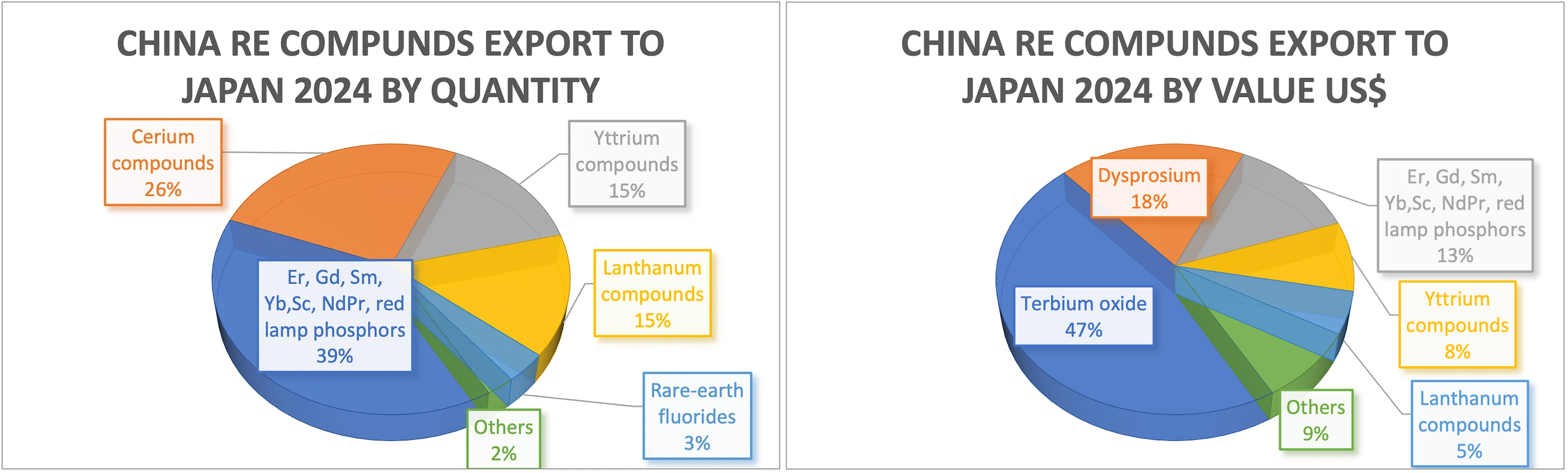
You can see that 54% by volume and 85% by value of China’s rare earth exports to Japan contain products that China put under dual-use license on 4 April 2025. The subject is not new, it is 9 months old.
Incentives for companies such as the Japanese-funded Lynas Rare Earths Ltd. have succeeded in broadening the sources of supplies of neodymium and praseodymium, but have been too slow in doing the same with harder-to-obtain samarium, dysprosium and terbium.
Lynas is substantially dependent on sales to China. However, whatever the difficulties, Japan Inc. will bail Lynas out.
Canada’s Neo Performance Materials Inc. took just 500 days to build a rare-earth magnet plant in Estonia that opened in September, with commercial sales due later this year.
If China starts playing real hardball with Neo then the company will have a massive problem, because its business depends on China. But that escapes the casual commentator of Bloomberg.
Nervous analysts over the past year have pointed to a quote from Deng Xiaoping as evidence of Beijing’s long-term masterplan: “The Middle East has oil; China has rare earths.” A better guide might have been another line often attributed to the former premier: “Hide your strength, bide your time.”
Deng Xiao Ping had been Vice-Premier at times between the 1950s and mid 1970s. But Deng has never been “premier”, prime minister of China.
At the time of the famous but out of context quote in 1992 Deng held no official position in either party or the state.
But why mind details and do proper homework when it is about China, right?
Of course China’s officialdom overplayed its hand at the expense of its rare earth industry and everybody else’s expense for that matter, but the consequences are not even remotely navigated as smooth and easy as Bloomberg is dreaming up.
It will be really messy and difficult before things could become any better.
Surprise, surprise!
Japan deep-sea rare-earth project begins off remote southern island
A Japanese marine research vessel set sail on Monday for a historic month-long mission to extract mud containing rare-earth elements from 6,000 meters beneath the Pacific Ocean near the remote island of Minamitorishima.
SIP and the Japan Agency for Marine-Earth Science and Technology (JAMSTEC), which is conducting the mission, call it “the first step toward industrializing domestically sourced rare earths in our country.”
The JAMSTEC research ship Chikyu left Shimizu Port in Shizuoka, central Japan, on Monday morning and is scheduled to return there in mid-February. The vessel is over 200 meters long and has a 70-meter drilling rig towering above the deck for seabed excavation.
This mission is primarily focused on operational verification ahead of a full-scale operational test in 2027. We will consider it a success if we can bring mud from the seabed aboard the ship," SIP Program Director Shoichi Ishii said ahead of departure on Monday.
Although SIP has not disclosed specific estimates of resource volumes for economic security reasons, it assesses the scale as “sufficient for industrial-scale development and capable of contributing to part of the supply chain.”
No longer a money matter, interesting.
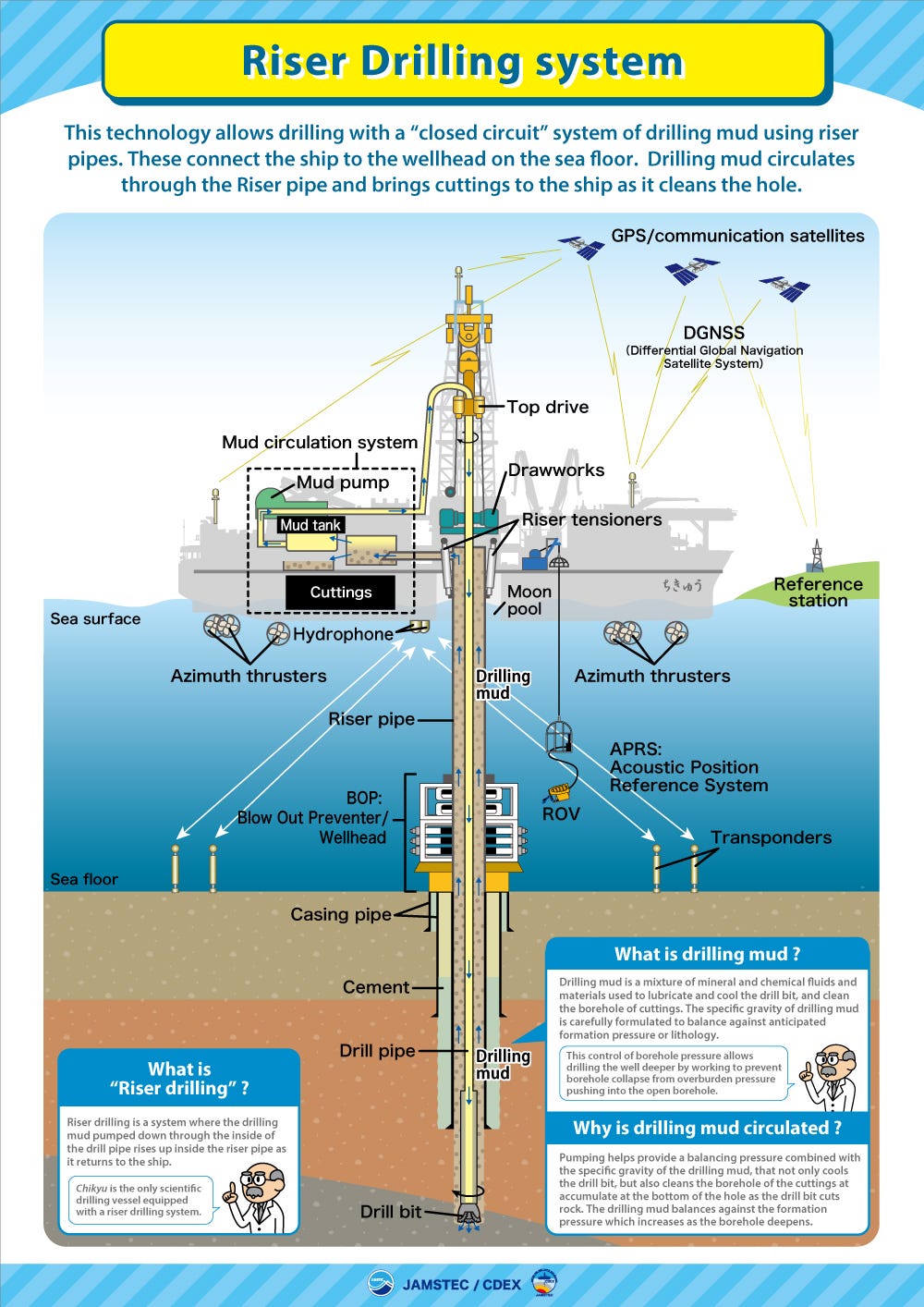
The system was designed for 1-2,000 m below ocean surface, not for 4-6,000 m. It is very interesting how Japan tries to battle the forces of nature kilometres below the ocean surfaces, rather than using a fraction of the money to turbo-charge projects on Earth’s surface.
Well, may be because JOGMEC bet on the wrong rare earth horse. See Namibia Critical Metals feasibility study in the “Companies” section below.
Under rare earth threat
Russia’s Nuclear Powered Navy
Keep reading with a 7-day free trial
Subscribe to The Rare Earth Observer to keep reading this post and get 7 days of free access to the full post archives.